

I’m currently knitting the Outline Tee: a bottom-up sweater that has you knit the body in the round and then separate to knit the top portions flat. This type of pattern construction can be tricky, and it often leads to a problem called rowing out if your purl stitches are looser than your knit stitches.
In this pattern, the designer Jessie Mae Martinson recommends that you may need to go down a needle size for the flat portions to maintain gauge, but I have a twist on that advice: just go down a needle size on one needle, not both!!

The Trick: Change Your Needle Size for Purl Rows
My fix is simple: go down a needle size for the purl rows. For my Outline Tee, I used a U.S. size 5 needle for the body in the round, and when I got to the flat portion, I set up my needles with a size 5 on one side and a size 4 on the other. That way, the knit stitches are still worked on the size 5, the purl stitches are worked on the size 4.
And, because I collect interchangeable needle sets from Knit Picks, I take things one step further and I use a needle from a different set for my “size smaller” needle. Here, I kept my Sunstuck wood needle tip for the knits and use a pink aluminum needle from my Prism set for the purls. This gives me a built-in visual reminder of what I’ve done so I won’t forget to change the needles back when I resume working in the round.
Rowing Out: What’s Really Happening in Your Knitting
Most knitters have some difference in tension between knit and purl stitches, even if it’s subtle. This is commonly called “rowing out.”
When you are rowing out, the fabric may look slightly uneven on the front, but it’s most noticeable on the back, where the purl bumps form a ridged pattern every couple of rows instead of a smooth even texture. Here’s a photo of a rowed-out baby blanket I made many years ago that illustrates this concept:
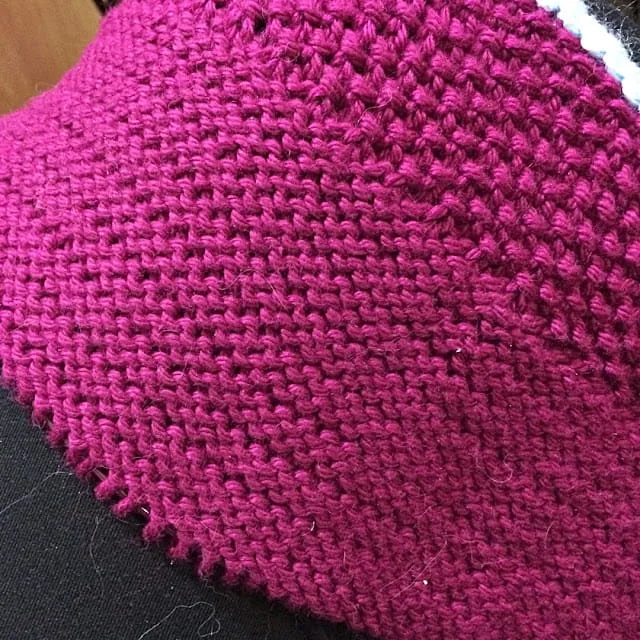
And here is the back of my current WIP where I do the mixed needle trick. See the difference?

Shhh… This Knitting Trick is Rarely Written Down!
Here’s the interesting thing: this mixed-needle tip is something many knitting instructors and designers mention in classes, but you’ll rarely see it written into a pattern. Most patterns simply tell you to “adjust your gauge.” So, this little trick of mixing needle sizes for knit and purl stitches is kind of like a behind-the-scenes secret you usually only pick up from a fellow knitter. So, if this tip is new to you… Welcome to the inner circle! Lol! (Ann Budd welcomed me into the circle via her Craftsy class Knit Like a Master – which is AMAZING!)
That said, I’m sure there are a zillion tricks just like this that resolve gauge issues when you switch from knitting in the round to knitting flat. Do you have a different way to do it? If so, please share in the comments so we can compare notes!


Leave a Comment